

Fast, lightweight local LLM inference.
An open-source LLM engine in a ~50 MB binary with zero dependencies. Native long context on one consumer GPU, tuned per GPU, no setup. Run GGUF models as they are and serve them to your browser, scripts and coding agents.
- Single binary
- ~50MB
- Dependencies
- 0
- Native context
- 256K
- RTX 5090 decode
- 350tok/s
Key features
Native long context, no quality loss
Every model gets its full trained context on a single consumer GPU. When the K/V cache outgrows VRAM it spills into system RAM instead of truncating: 123 tok/s at 256K on a 24 GB RTX 4090, with 100% long-context retrieval from 32K to 256K.
Tuned per GPU, zero manual flags
Measured kernel tuning tables for 11 NVIDIA GPUs. Context length, K/V precision and GPU/RAM placement are sized automatically from available memory.
No install, ~50 MB
CUDA and C++ runtimes are linked in; only the NVIDIA driver (580 or newer) is needed. No CUDA Toolkit, Python or Docker. One .exe on Windows, a ~45 MB tarball on Linux.
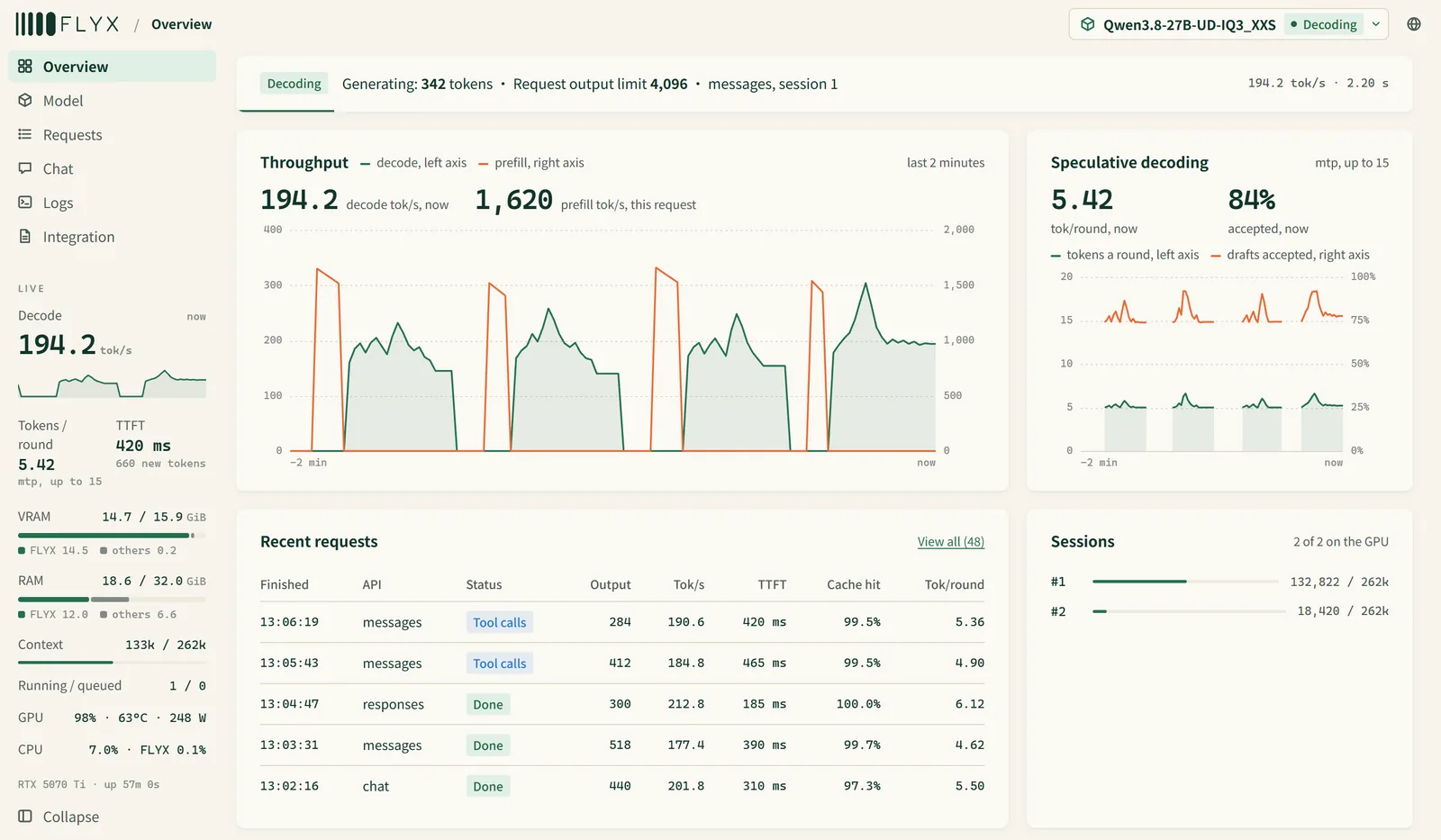
Built-in speculative decoding
MTP, DFlash2, DV and prompt lookup drafters, up to 3.3x faster decoding, with output that stays token-for-token identical to plain decoding.
One-click coding agents
Speaks OpenAI Chat Completions, Responses and Anthropic Messages with tool calls and prompt reuse. Launch Claude Code or Codex CLI from the dashboard, or copy commands for OpenCode, Pi and DeepSeek Harness.
Verified accuracy
Every GPU kernel is tested against a float64 reference. Default FP8 K/V stays within KL 0.0009 to 0.0016 of 16-bit on a 27B model.
Performance
Qwen3.8-27B GGUF with built-in MTP speculative decoding, greedy 512-token code generation at full 262K context. Decode speed in tokens per second.
| GPU | Quant | 1K | 128K | 256K | 256K retrieval |
|---|---|---|---|---|---|
| RTX 5090 32 GB | NVFP4 | 350.2 | 228.7 | 164.5 | 100% |
| RTX 5080 16 GB | UD-IQ3_XXS | 225.9 | 161.0 | 105.8 | 100% |
| RTX 5070 Ti 16 GB | UD-IQ3_XXS | 167.4 | 104.6 | 61.2 | 100% |
| RTX 4090 24 GB | UD-Q4_K_XL | 193.6 | 155.9 | 122.7 | 100% |
| RTX 4080 16 GB | UD-IQ3_XXS | 172.3 | 111.0 | 99.0 | 100% |
| RTX 3090 24 GB | UD-Q4_K_XL | 135.8 | 97.5 | 68.1 | 100% |
Needle-in-a-haystack retrieval at 256K: 100% on every GPU. Exact hardware, prefill times and commands to reproduce every number: benchmarks.
Quick start
Download
Get the latest build from GitHub Releases. Only an NVIDIA driver (580 or newer) is required.
Run
Windows: double-click
flyx.exe. Linux or WSL2: extract the tarball and run./bin/flyx serve. The dashboard opens at127.0.0.1:8080.Connect
Pick or download a model, then launch Claude Code or Codex from Integration, or point any SDK at the local server.
# Linux / WSL2: serve a Hugging Face GGUF directly
./bin/flyx serve unsloth/Qwen3.8-27B-GGUF:UD-Q4_K_XL

# OpenAI SDKs
OPENAI_BASE_URL=http://127.0.0.1:8080/v1
# Anthropic SDKs and Claude Code
ANTHROPIC_BASE_URL=http://127.0.0.1:8080
Supported models and hardware
Models
Qwen3.5 and Qwen3.8 (hybrid GDN and gated attention), Qwen3 dense, and Llama models such as MiniCPM5-1B. Dense text models; no MoE or vision yet.
Formats
GGUF as is: F16, BF16, Q4_0 to Q8_0, Q2_K to Q6_K, IQ1 to IQ4 and NVFP4. Plus the
.flyxformat with LoRA adapters.GPUs and platforms
GeForce RTX 30, 40 and 50 series, L4, L40S, A100 and H100. Windows, Linux and WSL2.
Questions
What is Flyx?
Flyx is an open-source (Apache-2.0) local LLM inference engine from Enwove. It ships as a single ~50 MB binary with no dependencies besides the NVIDIA driver, runs GGUF models as they are, and serves them over OpenAI- and Anthropic-compatible APIs.
Which GPUs does Flyx support?
NVIDIA GeForce RTX 30, 40 and 50 series, plus L4, L40S, A100 and H100 (sm_80 to sm_120). It needs NVIDIA driver 580 or newer and uses one GPU per process.
Which models does Flyx run?
Qwen3.5 and Qwen3.8 (hybrid GDN and gated attention), Qwen3 dense, and Llama-architecture models such as MiniCPM5-1B. GGUF files load directly, including K-quants, IQ quants and NVFP4. Dense text models only for now: no MoE and no vision. See the model guide.
Can I use Flyx with Claude Code, Codex or the OpenAI SDK?
Yes. Point OpenAI SDKs at http://127.0.0.1:8080/v1 and Anthropic SDKs or Claude Code (ANTHROPIC_BASE_URL) at http://127.0.0.1:8080. On Windows the dashboard can launch Claude Code or Codex CLI in your project folder with one click. Full API reference: CLI and API.
Do I need Python, Docker or the CUDA Toolkit?
No. CUDA and C++ runtimes are linked into the binary. On Windows you double-click a single .exe; on Linux you extract a ~45 MB tarball. Only the NVIDIA driver is required.
Is Flyx free?
Yes. Flyx is open source under the Apache-2.0 license and free to download from GitHub.
Try Flyx on your GPU.
Star the repo, report issues, or join the community on Discord.